Open Source CLI for AI Agents

Extremely token-efficient access to all your data sources

-- Introducing Max --
A federated, schematised, open source data query layer for agents and humans alike.

View on GitHub
HubSpot MCP
Google Drive MCP
Max

Find the top 10 most common double-barrelled surnames in our HubSpot contacts.
For each, how many Google Drive files mention the surname + "invoice" in the title?

Agent (MCP)
0 tokens
0s time
$0 cost
Agent + Max
0 tokens
0s time
$0 cost
~1x fewer tokens
~1x faster
~1x cheaper

Real-world benchmark. MCP figures extrapolated — terminated mid-run due to repeated recompactions.

How is this possible?

MCP servers are inherently restrictive - most are thin veneers over existing APIs. These APIs all come with their own unique rate limits, throughput speeds and search powers. For agents, these limitations can be debilitating.

The max protocol flips the model - it makes data available right where your agents need it, in a convenient CLI form; where they can cut, sed, grep, pipe and redirect at will.

The result is unfettered search, context-free operations and lightning-fast speeds.

Max is designed for...

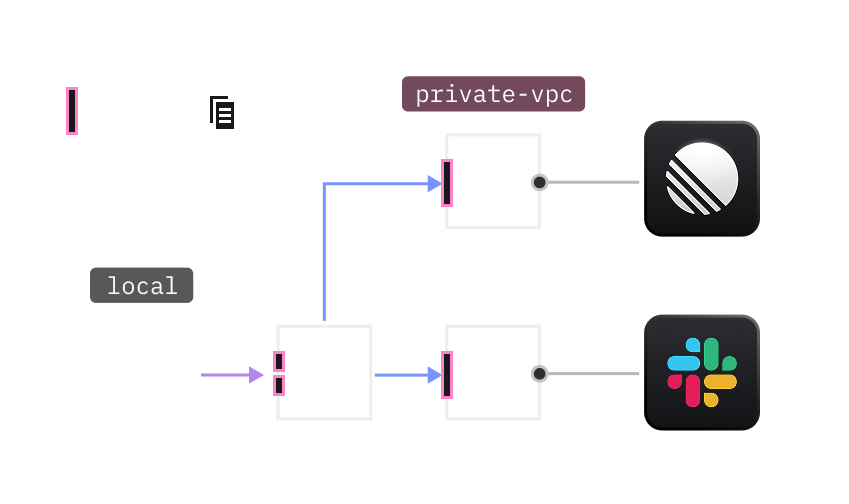
  • Federated data - create, reflect and consume from max nodes in any topology.
  • Federated governance - apply access controls and observability at the edges.
  • Unified search - a common lingua franca for unfettered search across all connectors.
  • Private and public connectors - connect to any source, create any connector.
  • Plugin architecture - extend max at ingest, index, storage, query and deliver phases.
  • Open source - max's core, protocols, library, CLI and platform bindings are fully open source under Apache 2.0.
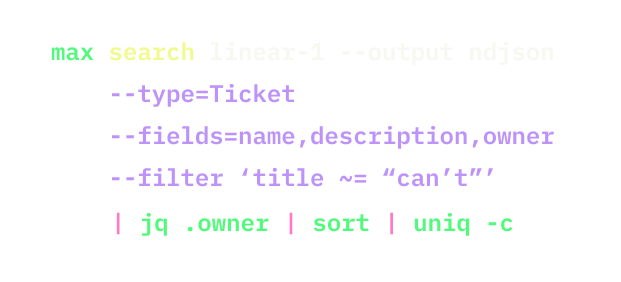
Max architecture diagram showing how data flows from sources through Max to your agent Example Max CLI command

Launch connectors

Tasks that are impossible or impractical with MCP.

AWS Cost Explorer
14 entities · 139 fields

Query 12 months of costs, forecasts, anomalies, budgets, and reservations in one shot.

MCP Rate-limited at 5 req/s. Dozens of paginated calls across costs, forecasts, anomalies, budgets, and reservations. Context overflows fast.
$ max search \ aws-cost-explorer-1 \ AWSCostAnomaly \ --filter 'totalImpact > 100'
RDS Performance Insights
5 entities · 31 fields

Rank the slowest queries with full SQL text, wait events, and CPU correlation — from an API no MCP server covers.

MCP No MCP server exists. The PI API requires sequential calls to get metrics, dimension keys, and full SQL text for each query.
$ max search \ aws-perf-insights-1 \ AWSPITopSQL \ --sort dbLoad | head
DataDog Incidents
3 entities · 26 fields

Analyze every incident this quarter with full details — severity, timelines, and customer impact across sources.

MCP Paginated at 100/page. Full incident details require N+1 calls. Cross-referencing with other sources is impractical.
$ max search \ datadog-incidents-1 \ DatadogIncident \ --sort timeToResolve
DataDog Metrics
resource metrics

Scan a week of 5-minute intervals across 50+ hosts to find who’s running hot.

MCP Time-series data — a week of 5-min intervals for 50 hosts is millions of data points. Impractical for a context window.
$ max search \ datadog-metrics-1 \ --filter 'cpu > 80' \ --fields host,cpu,memory
Jira Cloud
5 entities · 31 fields

Search every issue and comment across all projects — cycle time, stale tickets, and workload in one query.

MCP Paginated JQL at 100/page. Comments require N+1 calls per issue. Cross-project queries hit rate limits fast.
$ max search \ jira-1 \ JiraIssue \ --sort updated | head
Slack Export
4 entities · 26 fields

Query every channel, user, and message from a standard Slack export zip — no API token needed.

MCP No MCP server for export files. Thousands of JSON files across hundreds of channels. Too much raw data for a context window.
$ max search \ slack-export-1 \ SlackMessage \ --sort ts | head

View on GitHub